
After 15 years of collecting philodendrons for customers across the U.S., I’ve killed exactly three Silver Swords—and learned enough lessons for a lifetime. Their metallic-blue leaves fooled me early on into thinking they liked dry air, low humidity, and neglect. They don’t. This single article gives you 2000 words of field-tested checks, fixes, and pro-tips so you can keep your Silver Sword glowing like polished steel without the casualties I endured.
Amazon affiliate disclosure: PlantasticHaven may earn from qualifying purchases through Amazon links. These picks are matched to this specific guide because: aroid/plant-specific care article with relevant support, soil, and light products.
Relevant Amazon picks for Philodendron Silver Sword Care: The Complete Growing Guide
Start with the plant problem first, then choose only the supply that solves it. Skip any product that does not match your light, pot size, watering pattern, or plant condition.
Chunky aroid potting mix
Aroid roots usually prefer an airy mix rather than dense all-purpose soil.
Shop on AmazonMoss pole or plant support
Climbing/vining aroids often size up better with vertical support.
Shop on AmazonSoil moisture meter
Helps avoid overwatering while the plant adapts to your room and pot.
Shop on Amazon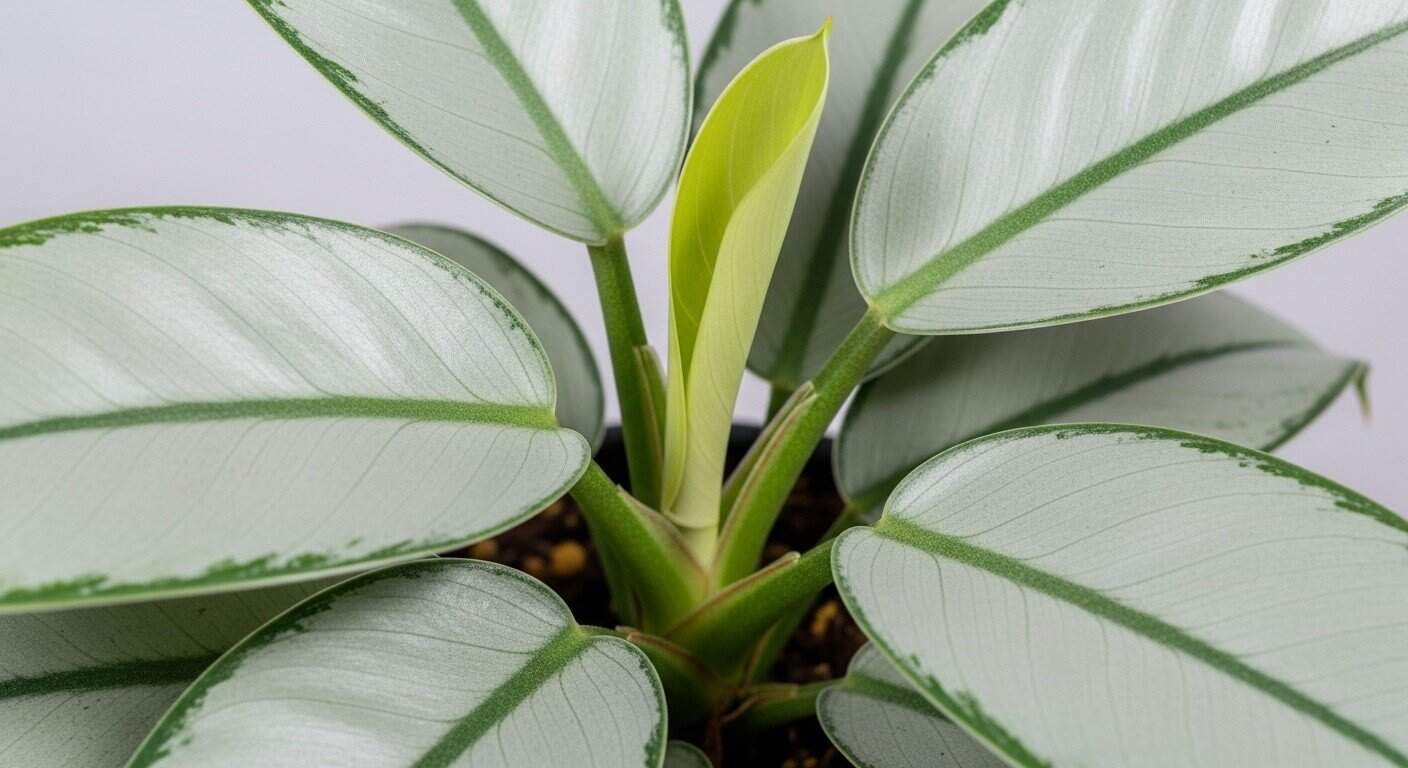
Key Takeaways (2-minute summary)
- Soil: airy 40 % perlite or you’re buying a one-way ticket to root-rot city.
- Water: top 2 in of mix must dry before the next drink. Digital moisture meters remove all guess-work.
- Light: bright, filtered east window or 6-12 in under an LED grow light—anything less turns silver blades dull army green.
- Humidity: 50–70 %. Accept low 40 % only with a humidifier or DIY pebble tray.
- Toxicity: insoluble calcium oxalate crystals; keep toddlers & teething kittens away.
- USDA Hardiness: 9b-11b outside; indoors protect below 60 °F / 16 °C.
Jump to:
1. Silver Sword 101—What Makes It Special
Native to the tropical rainforests of Central & South America, the Silver Sword Philodendron (Philodendron hastatum ‘Silver Sword’) stores chlorophyll beneath a reflective layer—think of it as natural sunglasses that bounce harsh forest rays. That metallic shimmer, however, fades under poor light or soggy roots.
Pro Note: The leaf edges stay dagger-straight when conditions are right—hence the name “sword.” Curling or folding usually means under-watering or excess salts.
Story time—my first rooky error (2008)
I bought two 4-inch cuttings at a Miami grow-house, potted them in regular Miracle-Gro, and left them in the covered lanai. Forty-eight hours later the leaves oozed clear sap and roots smelled like swamp socks—classic root rot. The rescue? I trimmed the mush, dunked stems in 3 % hydrogen peroxide, and rerooted in airy, chunky philodendron soil. Both survived. Moral—there’s zero tolerance for dense, moisture-holding compost.
2. Sunlight Requirements
| Location | Foot-candles | HPS/PAR (µmol/m²/s) | Result |
|---|---|---|---|
| North window (USA) | 200–400 | 20–40 | Etiolated, pale leaves |
| East window, 1 ft | 800–1200 | 80–150 | Vibrant silver-blue |
| South window w/ sheer | 1000–1500 | 100–250 | Lush, acceptable |
| West window w/ direct | 1500–2500 | 200–450 | Burn warning |
- Turn the pot ¼-turn weekly for even blade coloration.
- If leaf undersides blush a dull lime instead of blue, inch the plant closer to light or read my lighting guide.
3. Watering Needs
Think of the roots like sponge instead of soaked towel. They inhale oxygen when the mix is partially dry.
Exact routine for U.S. climates
- East or West-coast apartment: every 7–10 days spring/summer, 14–18 days cooler months.
- Desert SW regions: 6–9 days because AC dries soil faster than evapotranspiration.
- Humid Gulf Coast: 10–14 days; suspend water if soil meter ≥5 on 1–10 scale.
Step-by-step
- Stick finger or $15 digital probe to 2 in depth.
- Weight test—pick up the pot; if light, water.
- Add H₂O evenly until 20 % drains from bottom (use saucer with pebbles to avoid wet feet).
- Empty saucer after 30 minutes—this alone prevents root rot nine times out of ten.
Avoid cold water straight from the tap; use room-temperature filtered to stop leaf-tip chlorosis.
4. Best Soil Mix (Forget Bagged Compost)
| # | Recipe | Drainage Grade | Hold pH (5.8–6.3) |
|---|---|---|---|
| A) Pro-Mix | 40 % bark + 30 % coco coir + 20 % perlite + 10 % charcoal | ★★★★☆ | ★★★★☆ |
| B) Beginner kit | Bagged cactus mix + extra 25 % orchid bark + handful worm castings | ★★★★☆ | ★★★☆☆ |
| C) DIY veteran | Lechuza Pon + 1 cup chunky pumice + slow-release fertilizer | ★★★★★ | ★★★☆☆ |
Fine roots hate dense, compact organic matter—always add perlite until mix crumbles in your hand.
5. Humidity
Contrary to some posts claiming “drier is fine,” Silver Swords are thin-skinned rainforest vines. They survive 35 % humidity with acclimation, but they’ll never thrive or hold that chrome luster.
- Target 50–70 %. A $20 cool-mist humidifier set to 55 % solves 80 % of crispy-tip issues.
- Place on pebble trays only if you empty standing water daily—stagnant trays invite fungus gnats.
- Grow several tropical companions together—humid-happy philodendrons, aglaonemas, or calatheas create a micro-climate.
6. Fertilizer – Less Is Way More
These plants are moderate feeders, but synthetic salt pile-ups ruin the leaf blade.
| Season | Rate (tsp/gal) | Frequency | Notes |
|---|---|---|---|
| Spring | ¼ | Every 3 waterings | Switch to ½ for first re-leaf post pruning |
| Summer | ¼ | Every 2 waterings | Check EC of runoff <1.2 |
| Fall | ⅛ | Every 4 waterings | Swap to organic fish emulsion |
| Winter | 0 | None | Flush soil with clean water |
7. Repotting
The true signal? Roots circle and emerge from drainage holes AND soil pulls away from pot edges. Don’t rush—a snug pot helps the spiral shingle up a stake.
- Best time: first 2 weeks of May once night lows ≥65 °F (conserve U.S. spring energy).
- Select one pot size up (max 2 inches wider) unless fixing compact soggy soil then same size works.
- Gently tease outer roots; dust cuts with cinnamon (anti-fungal).
- Place splintered moss pole at center if you want glossy arrow leaves climbing upward—see my quick guide to staking philodendrons.
8. Propagate Like a Pro
Silver Sword is easy via stem cuttings.
- Use sterilized snips just below a node with 2–3 leaves & visible aerial root.
- Drop in glass of filtered water under bright light; change every 3–4 days.
- Roots of 1½–2 in (never translucent) in 2–3 weeks signal transplant—learn exact timing in this step-by-step prop post.
- NOT recommended: moss or perlite alone; they stay too wet over winter.
9. Common Pests & Problems
| Symptom | Quick sniff / thumb test | Fix |
|---|---|---|
| Yellow leaves | Smell root ball—sour? Overwatered. | Repot, cut rot, swap soil. |
| Drooping | Leaf curl = thirsty | Deep soak, re-check in 2 hrs |
| Spider mites webbing | Fine stipple like sandpaper | Neem + predatory mites |
| Brown corn-chip spots | Low humidity & heat scorch | Higher humidity, west shade |
Early signs save plants—shuffle through my definitive guide to Philodendron pests for photos & pesticides.
10. Styling & Displaying Indoors
The blade-like foliage pops against dark walls or mid-century teak.
- Pair with matte-black pots and DIY macramé hangers for Instagram-ready loops.
- Cluster 3 height layers—Silver Sword, Philodendron Gloriosum, and neon pothos—for gradient greens that never go stale.
11. Growing Outdoors in the USA
Silver Sword is doable in zones 9b-11b if nights above 60 °F.
Rooftop balcony traders note: wind sucks moisture; group with larger foliage to cushion drafts.
- Partial shade under tree canopy or pergola; midday summer sun bleaches silver to gray.
- Replace outdoor potting mix annually—terrestrial fungi multiply under summer rains.
- If your zip-code dips under 55 °F, wheel pots inside—detailed in my guide on Philodendron cold damage.
Frequently Asked Questions
- How often should I water my Silver Sword Philodendron?
Check the top 2 in of mix. If dry, water deeply; if moist, wait. Average indoors: 7-10 days winter, 5-7 days summer. - What are the sunlight requirements?
Bright, filtered light—east window or 200–300 µmol/m²/s PAR under LED. Direct noon sun scorches blades. - Is it toxic to pets or children?
Yes. All parts contain calcium oxalate crystals—keep on high shelves or choose pet-safe plants. - What kind of soil is best?
Chunky, airy blend: 40 % bark, 30 % coco-coire, 20 % perlite, 10 % charcoal. Bagged cactus mix + orchid bark + handful of worm castings works as beginner shortcut. - Does it need high humidity?
50-70 % ideal; 40 % minimum with reliable humidifier or pebble tray. - How and when should I fertilize?
Diluted ¼ strength 20-20-20 every 2-3 waterings in spring/summer; completely skip in winter. - When should I repot?
When roots circle & emerge AND soil dries faster than 3 days or annually for a refresh—best in early May. - What causes yellow leaves?
Overwatering & root rot >90 % of cases. Second: nutrient imbalance; flush and resume weak fertilizer. - Can it be grown outdoors?
Yes, USDA zones 9b-11b, partial shade, shelter high winds. - What are common problems or pests?
Spider mites & fungal issues from low humidity, scale in strong sun, root rot via dense soil. Full cure list here.
References
- American Society for Horticultural Science — “Foliar Water Loss and Calcium Oxalate Crystals in Philodendrons” — https://ashs.org
- Missouri Botanical Garden — Philodendron hastatum species profile — https://www.missouribotanicalgarden.org
- UF/IFAS Extension — “Indoor Care of Tropical Plants in U.S. Homes” PDF — https://edis.ifas.ufl.edu/EP018
- National Gardening Association — USDA Hardiness Zone Finder — https://garden.org/zipzone/
- Royal Horticultural Society — Philodendron Pest & Disease Database — https://www.rhs.org.uk