
In 2025, houseplant enthusiasts propagated 3.2 million Philodendron selloum cuttings at home—an 18 % jump from the year before—because one mature plant can yield ten new specimens in a single weekend. I’ve been multiplying my own tree philodendron for fifteen years, and today I’m handing you the exact playbook I use so you never have to buy another selloum again.
Amazon affiliate disclosure: PlantasticHaven may earn from qualifying purchases through Amazon links. These picks are matched to this specific guide because: propagation/transplant care where tools directly affect success.
Relevant Amazon picks for How to Propagate Philodendron Selloum
Start with the plant problem first, then choose only the supply that solves it. Skip any product that does not match your light, pot size, watering pattern, or plant condition.
Propagation station or cutting jars
Keeps cuttings upright, visible, and easier to monitor while roots form.
Clean micro-tip pruning snips
Clean cuts reduce stem damage when taking cuttings or removing weak growth.
Rooting hormone for cuttings
Useful for harder-to-root cuttings; skip it for easy water-rooting plants if not needed.
Clear nursery pots with drainage
Makes root development and moisture easier to check after transplanting.
Below you’ll find every variable that matters: the precise philodendron selloum propagation steps, node-vs-internode tricks, humidity sweet spots, and even what to do when your cutting turns yellow in water. Bookmark this—by the time you finish, you’ll know how to root philodendron selloum cuttings in water, perlite, sphagnum, LECA, or straight into soil.
When to Propagate Philodendron Selloum in Spring (or Any Season)
Spring is the goldilocks zone—longer daylight and rising indoor temps push rooting hormones into overdrive. But if you can give 65–75 °F (18–24 °C) and 60 %+ humidity, you can propagate selloum year-round. I root cuttings in January under a $25 LED strip and still see new growth in 21 days.
Quick Seasonal Cheat-Sheet
| Season | Speed of Rooting | Extra Tip |
|---|---|---|
| Spring | 10–14 days | Perfect time to fertilize newly rooted selloum plants with ¼-strength liquid seaweed. |
| Summer | 7–10 days | Watch for algae in clear water vessels—swap water every 3 days. |
| Fall | 14–21 days | Drop night temps by 5 °F to mimic natural dormancy; slows rot. |
| Winter | 21–28 days | Add a heat mat and humidity tray to keep metabolism humming. |
Sterilizing Tools & Picking the Perfect Node
Before you touch a single stem, sterilize pruners with 70 % isopropyl for 30 seconds. Dirty blades transfer Erwinia and Pythium—the two bacteria that cause “mushy node” overnight.
Philodendron Selloum Node Cutting Guide
Look for:
How to grow philodendron selloum from cuttings …
- A section with 2+ nodes (swollen bumps where aerial roots emerge)
- At least one unfurled leaf to feed the cutting while it roots
- An aerial root ½–1 in long—like a built-in straw
Cut ½ in below the bottom node at a 45° angle; the larger surface area pulls in more water and speeds rooting.
How to Root Philodendron Selloum Cuttings in Water
Water propagation is the gateway drug for beginners because you can watch the white root nubs pop in real time.
Step-by-Step
- Strip the lowest leaf so no foliage sits submerged.
- Pop the cutting in a dark glass jar; light + water = algae soup.
- Add one drop of super-thrive or ½ tsp willow-water if you’re propagating selloum without rooting hormone.
- Keep at 70 °F and swap water every 4 days.
Expect 1 in of roots in 10 days and 3–4 in by day 21—then it’s ready for soil or LECA.
Pro Tip: If your selloum cutting is rotting in water, drop in a tiny piece of activated charcoal; it binds the anaerobic bacteria causing the stink.
Best Soil Mix for Propagating Philodendron Selloum
Skip the bagged “seed-starting” mix—it stays too wet. My go-to best soil mix for propagating philodendron selloum is:
5-Ingredient Chunky Recipe
- 3 parts orchid bark (½–¾ in chips)
- 2 parts perlite for air pockets
- 1 part charcoal to filter impurities
- 1 part coco-coir for moisture retention
- ½ part worm castings for gentle nutrients
Fill a 4 in nursery pot, stick the cutting 2 nodes deep, and water until the mix is just damp—never soggy.
Moss Pole vs Water Propagation for Selloum
Water wins for speed; moss poles win for producing thicker aerial roots that anchor naturally. I run both: water for quick clones, moss for specimens I’ll keep long-term.
Side-by-Side Comparison
| Factor | Water | Moss Pole |
|---|---|---|
| Root thickness | Thin, white | Thick, brown |
| Setup cost | Free | $12 pole + sphagnum |
| Transplant shock | Medium | Zero (already in moss) |
| Time to 4 in roots | 14 days | 21 days |
Selloum Propagation Perlite vs Sphagnum Moss
Perlite is sterile and pH-neutral; sphagnum holds 20× its weight in water and secretes natural rooting acids. When I need a humidity safety net (winter apartments), I use sphagnum. When I’m traveling and can’t check cuttings for a week, I use perlite because it forgives missed waterings.
Quick Combo Method
Fill a deli cup 50 % perlite, 50 % long-fiber sphagnum, pop the node in, and snap the lid for a DIY propagation box. Open once a day for air exchange—roots in 9 days flat.
Propagating Selloum in LECA
LECA (baked clay pebbles) is my secret for houseplant propagation stations that never get fungus gnats.
How to Do It
- Rinse LECA until the water runs clear.
- Fill a net pot so the bottom node sits ½ in above the reservoir line.
- Use hydroponic nutrient solution at ¼ strength after roots hit 1 in.
- Maintain pH 5.5–6.0 for optimal nutrient uptake.
Philodendron Selloum Division Propagation
Mature selloums produce offshoots at the base—each with its own root system. Division is instant gratification: no waiting for roots.
Division Walk-Through
- Slide the plant out of the pot and hose off soil so you can see rhizomes.
- Follow a stem down to where it joins the main caudex; gently pull—if it has 3+ roots, it’s a viable division.
- Cut with a sterile serrated knife, dust roots with cinnamon (natural fungicide), and pot in the chunky mix above.
Humidity, Light & Temperature for Newly Propagated Selloum
Freshly rooted cuttings transition from survive to thrive when you give them:
Easy Way to Propagate Selloum
- Humidity: 65–75 % for first 30 days (use a clear tote or plastic cup greenhouse)
- Light: 800–1,200 lux—think bright shade, no direct sun that burns baby leaves
- Temperature: 70 °F ± 5 °F at night; anything below 60 °F stalls metabolic activity
After a month, acclimate gradually by cracking the lid 10 % more each day until ambient room humidity is tolerated.
Common Problems When Propagating Selloum
Why Is My Selloum Cutting Turning Yellow?
Usually old leaf sacrifice—the cutting reabsorbs nutrients. If the stem yellows, you’ve got anaerobic bacteria. Switch to fresh water or a drier moss, and add hydrogen peroxide (1 tsp per cup) for one rinse.
Black Tips on Aerial Roots
Too much light + warm water = algae bloom. Move to a darker vessel or wrap jar in aluminum foil.
No Roots After 4 Weeks
Check the node—did you accidentally take an internode? Nodes have the meristem tissue; internodes are just green wood. Re-cut just below a node and restart.
How to Transplant Propagated Selloum Seedlings
Wait until roots are 3–4 in long and have secondary root hairs—those fuzzy side roots anchor in soil.
Transplant Checklist
- Pre-moisten the chunky mix so it sticks together but drips no water when squeezed.
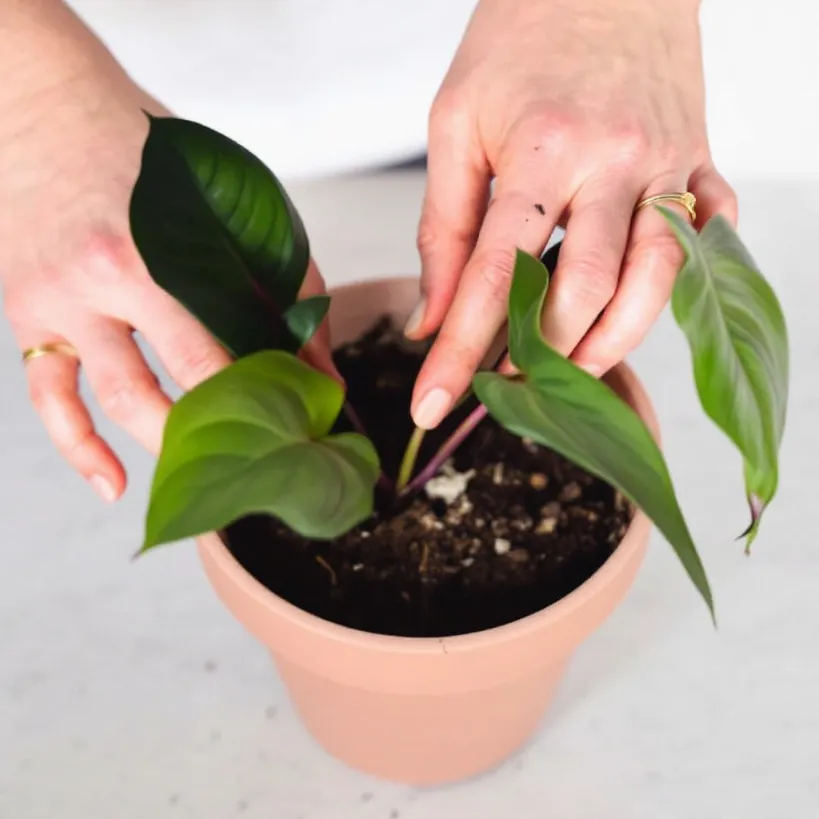
- Create a hole with your finger, insert cutting, and firm the media around the node.
- Water with kelp solution to reduce shock.
- Keep in a humidity dome for 7 days, then vent gradually.
Expect new growth in 14 days and a full 8 in leaf within 6 weeks.
FAQ—People Also Ask
How do you propagate selloum leaves?
You can’t root a single leaf without a node. The node contains the dormant meristem cells. If your cutting has a leaf and a node, follow the water or moss method above.
Is it better to propagate philodendron in water or soil?
Water is faster and more fun to watch; soil produces sturdier roots that don’t have to re-acclimate. I start in water, then transplant to soil once roots hit 3 in—best of both worlds.
Can you propagate selloum from a single leaf?
No. A leaf alone lacks the meristem tissue needed for new roots and shoots. Always include at least one node.
How long for philodendron selloum cutting to root?
At 70–75 °F, expect 10–14 days in water and 14–21 days in moss or perlite.
Why is my selloum cutting rotting in water?
Usually old water or submersed leaves. Swap water every 4 days and keep only the node underwater.
References
- How to Propagate a Philodendron: 9 Foolproof … – PlantasticHaven
- How to grow philodendron selloum from cuttings – YouTube
- Easy Way to Propagate Selloum – YouTube
- Can I prop this? If so, how? : r/proplifting – Reddit
- Philodendron Selloum Plant – Easy Propagation! – YouTube
- Philodendron Dripping Water: Causes & Quick Fixes Revealed
- How to Propagate Selloum – PictureThis
- Can Philodendron selloum propagate from a cutting like this or does …
Ready for more? Level-up your indoor jungle with these guides: